Why the Pomodoro Technique Doesn't Work for Deep Work
The Pomodoro Technique is great for shallow tasks, but it actively sabotages deep work. Here's why 25-minute intervals fragment your focus instead of enhancing it.
Why the Pomodoro Technique Doesn't Work for Deep Work
For years, the Pomodoro Technique has been the default productivity method recommended to knowledge workers. Set a timer for 25 minutes, work, then take a 5-minute break. Repeat. It sounds simple, effective, and structured.
But here's the problem: The Pomodoro Technique actively sabotages the kind of deep, focused work that creates real value.
The Flow State Problem
Research in cognitive psychology shows that it takes 15-23 minutes to enter a deep flow state. This is when your brain fully engages with a complex problem, holds multiple concepts in working memory, and produces your best work.
With Pomodoro, you're interrupting yourself just as you're getting into flow. You spend the first 15-20 minutes warming up, get 5-10 minutes of actual deep work, then the timer goes off.
The Context Switching Cost
Every break—even a short one—forces a context switch. Your brain has to:
- Save the current state of your work
- Disengage from the problem
- Reload everything when you return
This isn't free. Studies show context switching can reduce productivity by 40% and increase error rates. Those "harmless" 5-minute breaks aren't harmless at all.
When Pomodoro Actually Works
To be fair, Pomodoro isn't entirely useless. It works well for:
- Email processing - Shallow, discrete tasks
- Administrative work - Things you're avoiding
- Learning new habits - Building time awareness
- Fighting procrastination - Creating artificial structure
But these aren't deep work. They're shallow work dressed up with a timer.
What Deep Work Actually Needs
Real deep work—programming, writing, design, research, strategic thinking—needs sustained attention. Not 25 minutes. Hours.
Cal Newport, who coined the term "deep work," recommends blocks of 90-180 minutes. This aligns with your ultradian rhythm—the natural 90-minute cycles your brain operates on.
The Better Approach: Long Sprints with Flexible Breaks
Instead of forcing your work into arbitrary 25-minute boxes, try this:
- Set up a long sprint (2-4 hours)
- Work until you need a break (not when a timer says)
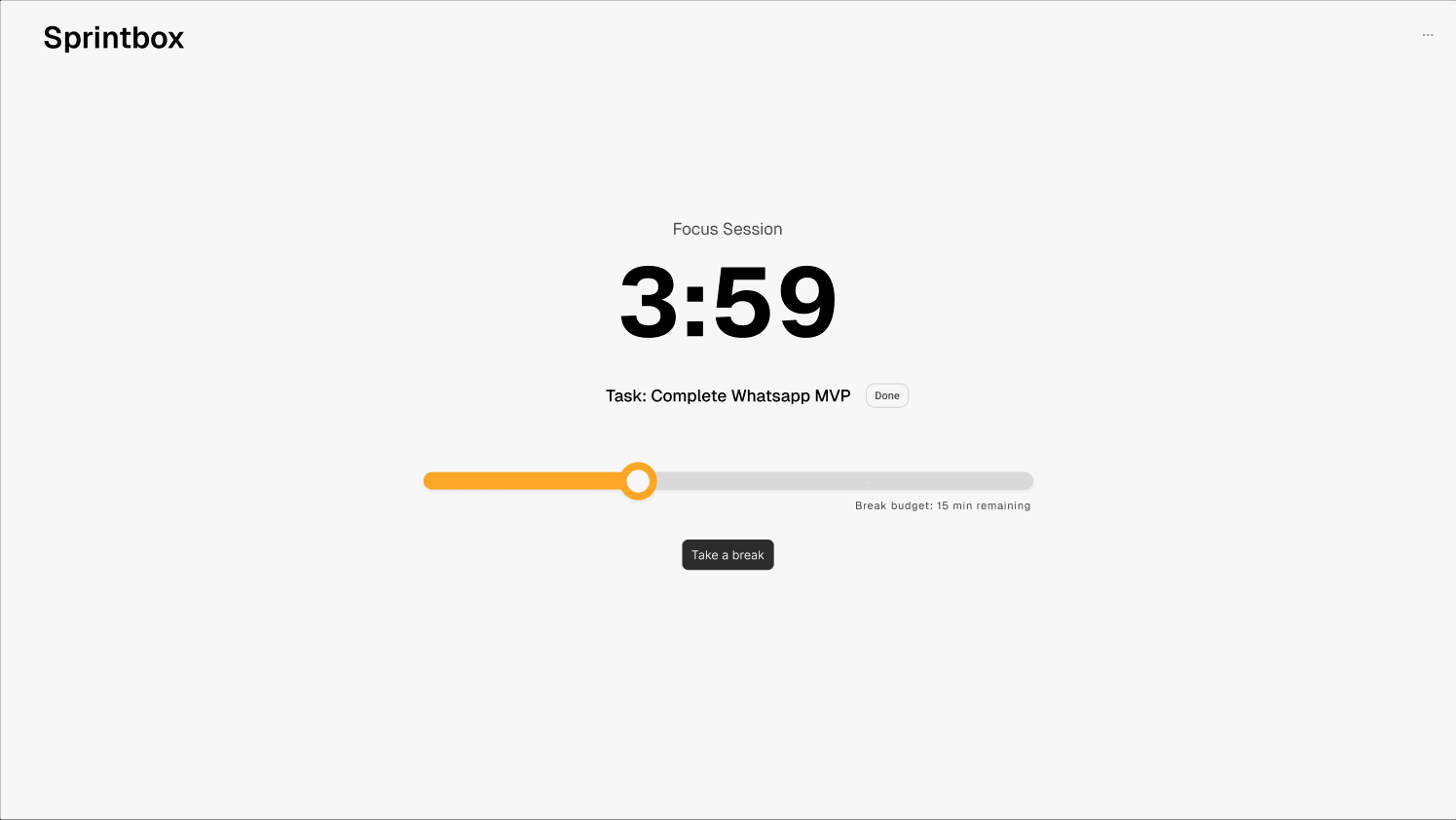
- Use a break budget (e.g., 15 minutes total in a 4-hour sprint)
- Take breaks when they're actually needed
This is how Sprintbox works. You get the structure of time-boxing without the fragmentation of constant interruptions.
The Bottom Line
Pomodoro is a hammer, and not every problem is a nail. If you're doing shallow work, it's fine. But if you're trying to do work that actually matters—work that requires thinking deeply about complex problems—stop fragmenting your day into 25-minute pieces.
Give yourself permission to work for hours. Your best work isn't in the next Pomodoro. It's in the next three hours of uninterrupted focus.
Ready to try a better approach? Sprintbox gives you the structure of time-boxing with the flexibility to actually get into flow. Start your free trial.